spiez: a place of joy
Following the Trail of Spiez

Spiez is not just any beautiful place. Spiez is an exceptionally beautiful place – and one that holds a few secrets too. An intriguing journey through past and present.

The People of Spiez, Their Castle and Their Town
Spiez was already inhabited in the Bronze Age, as countless archaeological traces have revealed. However, its history becomes much more tangible from the High Middle Ages onwards. In the 13th century, the small town of Spiez, enclosed by a wall and gate, developed at the foot of the medieval castle complex. In 1280, King Rudolf I of Habsburg granted the town the right to hold a weekly market. As a royal privilege, this was also a mark of distinction.
By 1289, the regional Barons of Strättligen were already co-owners of the castle. Following the king’s death in 1291, they and other noble families shaped the fortunes of Spiez and its farming communities for many years.
During the period when the Lords of Strättligen owned Spiez Castle, the town even made a small appearance on the European stage – not as a major player, but, perhaps surprisingly, through its musical contributions. One member of the Strättligen family appears not only as a minnesinger in the Manesse Codex, but was also a singing guest at gatherings of the nobility.
History and Stories
The history of Spiez can still be encountered in many places on a walk through the town today. And, like a secret, this history reveals its origins to those who look closely. One example is the famous Katzenstein viewpoint at the start of the Spiez Vineyard Discovery Trail. The last Ice Age brought this enormous boulder to its present location. Viewed from the right angle, the rock resembles a cat, which is how it got its name. It offers a vivid reminder of the immense forces that shaped Lake Thun only a few thousand years ago.
The early medieval church on the Spiez promontory is unique in both its age and architecture. The present church was probably built in the 11th century on the foundations of an earlier structure first mentioned in 762. It is one of the oldest architectural monuments in the wider region.
The church tower rises above the nave and choir, which in turn rests on a crypt that is unique in its design. Accessible only from the side aisles of the choir, the crypt is one of the oldest parts of the church. The ensemble is officially listed among Switzerland’s cultural assets worthy of protection.
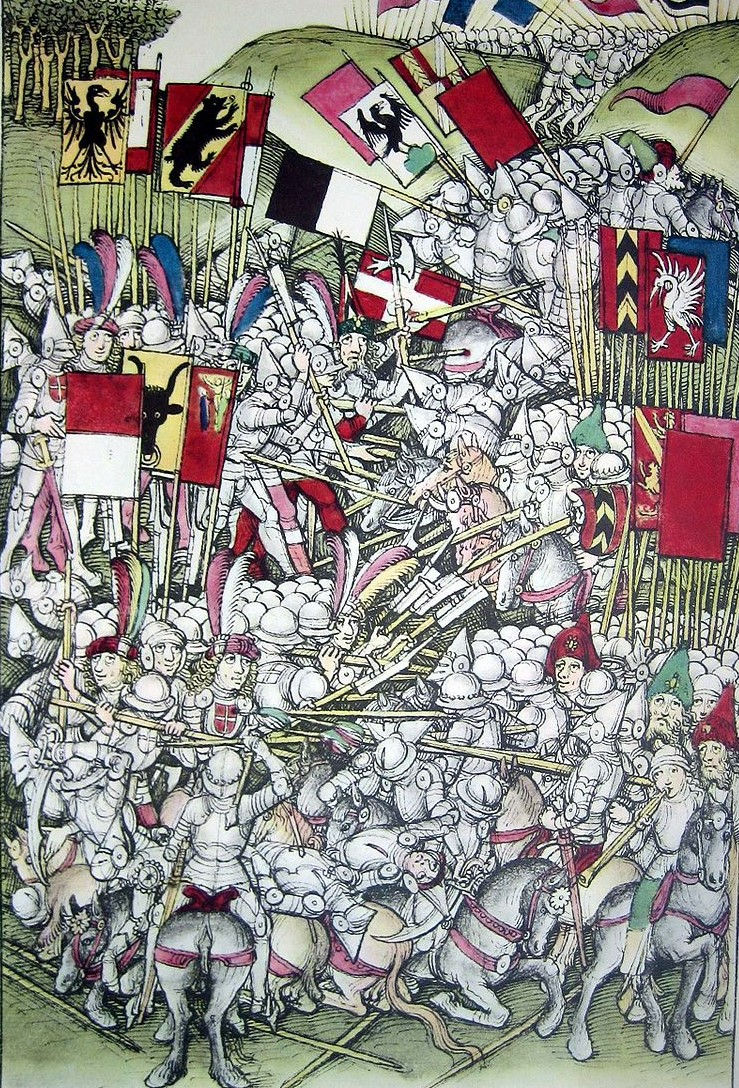
History was also recorded at Spiez Castle, which gradually evolved from the medieval fortress. In the 15th century, the chronicler Diepold Schilling wrote several chronicles, first in Bern and later here at the castle, that became part of Swiss history. Among other things, they contain the earliest depiction of the predecessor of today’s Swiss flag from the Battle of Laupen (1339).

Among the things that connect us to present-day Spiez are the Local History and Viticulture Museum, now around 300 years old, and the Spiez water supply. Established in response to the growth of tourism at the end of the 19th century, the water supply was founded jointly with the neighbouring municipality of Aeschi in 1901 and, more than 125 years later, continues to provide drinking water of demonstrably excellent quality.
All of this must be seen alongside the fundamental role of the railway in the development of Spiez as a transport hub. The railway also arrived at the end of the 19th century and remains part of the “soul of Spiez” to this day.
The Light of the Bay and the Joy of Spiez
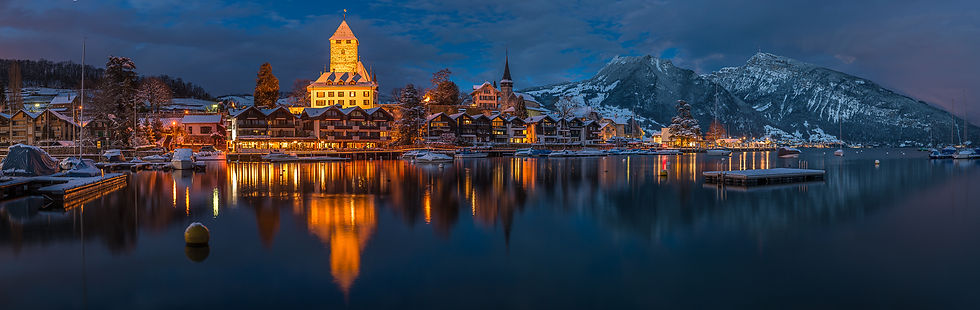
When you experience Spiez first-hand, its unique light immediately catches the eye. The light in Spiez Bay is particularly captivating at almost any time of day. It is so striking that it evokes comparisons with the Mediterranean: palm trees, flowers and lush gardens, together with the nearby vineyards, enhance the truly dazzling experience in what is said to be “Europe’s most beautiful bay”. The peaks of the High Alps, not so far away, form a contrasting and invigorating backdrop to Spiez.
The cool air flowing down towards Spiez from the Bernese mountains also gives Spiez wine an almost unique flavour profile, with a characteristic freshness and depth.
And finally, what would Spiez be without its festivals? Läset-Sunntig, Chlouse-Märit and the typically Spiez “Usestuehle” are just a few examples of the town’s lively social traditions.
These are all secrets waiting to be discovered by those who take the time to explore Spiez.
Martin Natterer